Showing posts with label social login. Show all posts

Monday, 21 April 2014

How to Create Meaningful Omni-channel Experiences: 5 Examples of Brands Getting It Right by Rachel Serpa

Worldwide smartphone users are expected to total 1.75 billion this year (eMarketer), with 56% of US adults boasting smartphone ownership (Pew). At this point, mobile-friendly sites are hardly just a perk or pleasant surprise – they’re a status quo expectation – yet many brands’ concept of “omni-channel” is still restricted to “responsive design.”
The ever expanding list of social platforms, communication mediums and connected devices presents a huge opportunity for businesses not to just replicate user experiences across channels, but to reach consumers in a variety of new and engaging ways. Today’s leading brands are taking this a step further by connecting these cross-channel experiences in a way that builds customer relationships and lifetime value.
Here are 5 examples of brands creating omni-channel experiences with purpose and effective outcome.

24 Hour Fitness

24 Hour Fitness created an online and in-club customer referral program that enables existing members to share a free 3-day gym pass directly with their social networks. Referees receive guest passes and additional information and promotions via email, while 24 Hour Fitness rewards top referrers by sending them personalized gift packages, effectively uniting social, email and real-world mediums.
The Effect: A significant increase in consumer trust and acquisition via member referrals, as well as a bump in customer loyalty and lifetime value.

Capcom

Video game giant Capcom promoted the relaunch of its Devil May Cry (DmC) franchise with an exclusive mobile app featuring gamification challenges that spanned both virtual and real-world channels. After logging in socially to the DmC app, users could participate in missions to scan various real-world objects, posted on the DmC website each week. Participants that completed the assigned missions scored virtual points, which could be redeemed inside the video game.
The Effect: A 500% increase in unique visits to the Devil May Cry mobile app by highly engaged users that logged in an average of over 6 times. These loyal users translated into over $1 million in game sales in the month following the app’s launch.

White Castle

Users can login to White Castle’s Craver Nation network using their social identities to start posting their best White Castle related photos and videos via desktop, mobile, or directly from Facebook. Cravers can earn badges and points for participating in and winning various real-world challenges, like cook offs and costume contests. Challenge submission photos are voted on by other Cravers, and can be seamlessly shared across Twitter, Facebook, Google+ and Pinterest.
The Effect: An interactive community that keeps Cravers coming back for more by putting the White Castle brand at the center of real-life activities and building personal relationships on-the-go, in real-time.

Victoria’s Secret

Victoria’s Secret Angel Card rewards program enables shoppers to share and earn points by shopping both in-store and online. Members receive personalized email alerts regarding special offers and promotions, get free gifts and birthday presents, and gain access to special events and exclusive discounts. Card holders also receive extra rewards for connecting their social profiles to their accounts.
The Effect: A personalized customer experience that recognizes and fosters brand advocacy while driving repeat purchases.

KLM

By connecting mobile, social and in-air – that’s right, in-air – experiences, KLM Royal Dutch Airlines has built a totally unique omni-channel journey for flyers. When users login to the Meet and Seat mobile app using their existing social network identities, they are able to see the social details and seating assignments of other participating passengers on their flight. From there, they are able to select a seat next to the passenger with the most intriguing social profile.
The Effect: A totally social, memorable flying experience that not only makes KLM stand out, but fosters a connected community of flyers that choose to get on board time and again.

Each of these examples showcases the power of omni-channel experiences to create an end-to-end customer journey that drives customer acquisition, engagement and retention across touchpoints. Are you ready to go beyond responsive design? For more information on how to create meaningful omni-channel user experiences, download our free white paper, 3 Ways to Create an Effective Omni-channel Strategy.

Tuesday, 4 February 2014

3 Challenges Facing Marketers in 2014 By Emma Tzeng

It’s nearly unthinkable to consider how far marketing has traversed in the past year alone. While marketers continued to hone their social strategies and experiment with big data and omni-channel tactics in 2013, this coming year will pose its own hurdles, as businesses concentrate their efforts on unifying user experiences, achieving provable social ROI, and knowing their customers in even deeper, more actionable ways.
This article dissects three major challenges marketers will come head to head with this year, along with action plans for tackling and overcoming these obstacles.

Challenge #1: Unifying Cross-Channel Experiences with First Party Data

In 2013, eMarketer reported that 45% of consumers prefer shopping experiences that combine online, mobile, and in-store interactions. As customers interact more with brands across multiple devices, however, marketers need to figure out how to obtain a consistent view of consumer identity over a variety of mediums.
To complicate the matter, traditional retargeting techniques that utilize third party cookie data to construct inferred consumer personas don’t translate to mobile. As the average time spent on mobile devices exceeds desktop usage rates and consumers become increasingly social both online and offline, marketers are more pressed than ever to rely on first party data to inform their marketing strategies and craft unique customer experiences.
(Source: eMarketer)

Solution: Social Login for Access to First Party Data

The best way to acquire firsthand insights on your users is to start at the source — their social networks. Social networks like Facebook, Twitter, and Google+ collect millions of actionable data points on their users such as their locations, emails, genders, interests, likes, social graphs, and more. Businesses can gain direct access to these insights by leveraging social login on their digital properties, which captures social profile information in a permission-based manner.
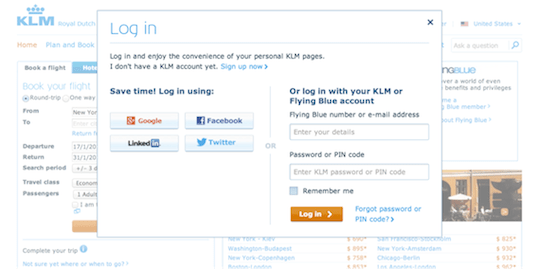
For example, Dutch airline KLM incorporates social login into its digital experience, offering four different social provider options and displaying a prominent call to action for a streamlined user experience that encourages more consumers to log in socially. As these users choose social login, KLM gets access to valuable social profile information that it can leverage to personalize user experiences across channels.
In KLM’s instance, the airline uses social login to power its Meet & Seat program, which lets flyers see who else is on board their flight and select seats based on other flyers’ seat assignments.
By integrating social into its in-flight experiences, KLM gathers valuable data on its customers while facilitating serendipitous, memorable opportunities for their flyers to connect with one another offline.

Challenge #2: Proving the ROI of Social

As we discussed earlier, social login is the gateway to firsthand consumer insights. These insights, in turn, can be analyzed and measured to determine just how much direct value social delivers to your marketing initiatives.

Solution: Measurable Insights Offer a Deeper Dive into ROI

We’ve outlined three factors to measure to effectively determine the ROI of your social marketing efforts:
  • Increase in registrations – How much have site registration numbers increased since implementing social login?
  • Value of a registered user – To determine the value of a registered user, you’ll want to examine the estimated return for new user registrations. Take the following example: An ecommerce site registers 10,000 users a month. Of these registrations, 500 users go on to make purchases on the site over the span of a year. If each purchaser’s average shopping cart conversion is $75, then the value per registered user is $3.75. What is the value per registered user for your business?
  • Decrease in forgotten password help desk issues – When users log in socially, they save themselves from having to remember another username and password combination; your business, in turn, avoids the hassle of dealing with lost password recovery issues. What is the decrease in support costs since implementing social login?
Check out our white paper, Path to ROI: Boosting Demand Gen and Improving Conversions with Social Login, for a deeper dive into how capturing social identities directly affects ROI.

Challenge #3: Knowing Your Customers in Even Deeper, More Actionable Ways

As users’ Internet habits evolve, we’re seeing a greater shift in online sharing: consumers are posting personal photographs, life events, and more across their social networks. This move towards a more connected, open social web reflects how consumers and businesses should interact in a landscape that encourages the sharing of users’ information in a safe, valuable way.

Solution: Schemaless, Social-Optimized Database for Seamless Data Storage

To facilitate this process, you should invest in a database that is not only secure but also fully equipped to handle the varied, dynamic nature of social data. This database structure is known as a schemaless database, and it enables sites and apps to store all types of unstructured (social and behavioral) data without any constraints.
After finding a secure data management system to store and manage your users’ data, you’ll want to invest in a marketer-friendly, web-based dashboard that enables marketers to access user data, define their audience segments, and apply these findings directly to their marketing strategies. This grants you full control over your marketing efforts, allowing you to work with the data to glean new insights on your user base and turn these insights into measurable actions.

In 2014, Personalization Triumphs

As consumers continue gravitating towards personal online experiences, it’s important for businesses wanting to retain a loyal customer base to remain a step ahead of their users. This means swapping mass marketing techniques for tailored messages that speak to users on an individual level. Businesses that successfully carry this out can expect to see real ROI on their marketing campaigns.